How to Solve Sudoku: Techniques from Easy to Expert
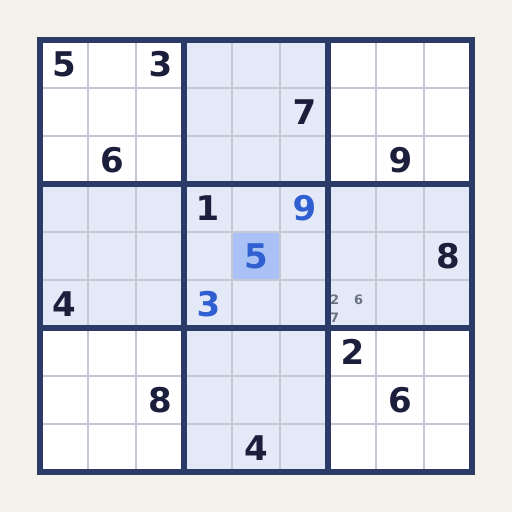 SudokuFree to play in your browserPlay
Sudoku looks like a maths puzzle, but there is no arithmetic in it at all. The numbers 1 to 9 could just as well be nine colours or nine letters. What you need is a small set of logical techniques, applied in the right order. This guide goes through them from the simplest to the ones that crack Expert grids, and explains what each difficulty in our Sudoku asks of you.
The one rule
Every row, every column and every 3×3 box must contain each number from 1 to 9 exactly once. That means every filled cell rules its number out of 20 other cells: the 8 others in its row, the 8 others in its column, and the 4 cells of its box that aren't already in that row or column. Every technique below is just a clever way of using that fact.
What the difficulty levels mean
Every puzzle on Caie Games is generated fresh and checked by a solver to make sure it has exactly one solution, so you never need to guess. The levels differ in how many numbers you start with and which techniques you need:
- Easy starts with about 40 numbers and can always be finished using only the two "single" techniques below.
- Medium starts with about 33 numbers. It still never needs more than singles, but they are harder to spot.
- Hard starts with about 28 numbers, and the generator tries to make sure singles alone are not enough, so you will need pencil marks and pairs.
- Expert starts with about 24 numbers and usually needs several of the advanced techniques in a row.
The daily puzzle is a Medium grid, and it is the same puzzle for everyone on the same day.
Technique 1: scanning for hidden singles
Pick a number, say 7, and look at one box. Follow every 7 that is already on the board along its row and its column, and mentally cross out the cells of the box it passes through. If only one empty cell in the box is left uncrossed, the 7 must go there. This is called a hidden single: the cell may have other candidates, but it is the only home for that number in that box.
The fastest way to start any grid is to scan this way number by number, starting with the numbers that already appear most often. If there are six 4s on the board, the remaining three are usually easy to place.
The same idea works for rows and columns. If a row has only two empty cells and one of them is blocked for 3 by a 3 in its column, the 3 goes in the other one.
Technique 2: naked singles
Now look at it from the cell's point of view. Take one empty cell and list every number already in its row, column and box. If eight different numbers are ruled out, the ninth is the answer. This is a naked single. It works best on cells in crowded areas of the grid, where a row and a box are both nearly full.
Easy and Medium puzzles can always be solved by alternating between these two techniques. When one stops working, switch to the other, because every number you place opens up new singles.
Technique 3: pencil marks (notes)
From Hard upwards you will reach a point where no single is visible. That is the moment to switch on Notes (the Notes button, or the N key) and write the possible candidates into the cells. You don't need to fill in the whole board. Start with boxes, rows or columns that have only three or four empty cells, because their notes are short and useful.
Our Sudoku helps here: when you place a correct number, it is automatically removed from the notes of every cell in the same row, column and box. Keep your notes honest, though. A single wrong note can hide the next step for a long time.
Technique 4: naked pairs and triples
If two cells in the same row, column or box both have exactly the same two candidates, for example {2, 6} and {2, 6}, then one of them is the 2 and the other is the 6. You don't know which yet, but you do know that no other cell in that unit can be a 2 or a 6. Erase those two numbers from the notes of the other cells, and singles often appear straight away.
The same works with three cells and three numbers: if three cells in a unit only contain candidates from {1, 4, 9}, those three numbers are locked into those three cells. The cells don't all need all three numbers; {1, 4}, {4, 9} and {1, 9} is a naked triple too.
Technique 5: pointing and claiming
Look at one box and one number. If every possible place for that number inside the box lies in the same row, the number must end up in that row within this box. So it can't appear anywhere else in that row, outside the box. Erase it from those cells. This is called a pointing pair (or triple).
It also works the other way round. If, in some row, a number can only go in cells that all belong to the same box, then that box's copy of the number is in this row, and you can erase it from the box's other rows. This is sometimes called claiming or box-line reduction. Pointing and claiming crack most Hard grids.
Technique 6: hidden pairs
A hidden pair is the mirror image of a naked pair. If two numbers can each only go in the same two cells of a unit, those two cells must hold those two numbers, even if their notes show other candidates too. Delete the other candidates from both cells. Hidden pairs are harder to see, which is why they show up so often in Expert puzzles.
Technique 7: the X-wing
Pick a number. If in two different rows it can only go in the same two columns, the four cells form a rectangle. In each of those rows the number is in one of the two columns, so between them the two rows use up both columns. You can erase the number from every other cell in those two columns. The same works with columns and rows swapped. You won't need it often, but when an Expert grid stalls with lots of notes, an X-wing is usually hiding somewhere.
Habits that make you faster
- Always come back to scanning. After every advanced step, scan for singles again before looking for the next clever trick.
- Work on the most-filled units first. A row with two blanks is solved much faster than one with seven.
- Don't guess. Every puzzle here has one solution that can be reached by logic. If you are about to guess, look for a pair or a pointing pattern instead.
- Use hints to learn. You get three hints per puzzle. A hint fills in the cell you have selected, or, if you haven't selected one, the cell with the fewest possible numbers. After using one, work out why that number was right.
- Mind the mistake limit. Three wrong numbers end the puzzle. When you are not sure, write a note instead of a number.
Keyboard shortcuts
On a computer, you can play without the mouse: move with the arrow keys, type 1 to 9 to place a number, Backspace to erase, N to switch notes on or off, Z to undo and H for a hint. Your game is saved automatically, so you can close the page and finish later.
SudokuFree to play in your browserPlay