Mahjong Solitaire Strategy: Rules, Tiles and How to Clear Every Layout
 Mahjong SolitaireFree to play in your browserPlay
Mahjong Solitaire uses the tiles of the old Chinese game, but it is a different game entirely: a calm, single-player matching puzzle. The tiles are stacked into a layout, and you clear it by removing matching pairs. Because every deal in our Mahjong Solitaire is built so that it can be won, losing is always a question of which pairs you took, never bad luck. This guide is about taking the right ones.
The free-tile rule
You can only take a tile when it is free. A tile is free when:
- no tile is lying on top of it, not even partly, and
- its left side or its right side is open (no tile directly next to it on that side at the same height).
Tiles above and below it on the screen don't matter. Only left, right and on top. That is why long rows are cleared from the ends inward, and why high stacks have to be taken from the top down.
The tiles
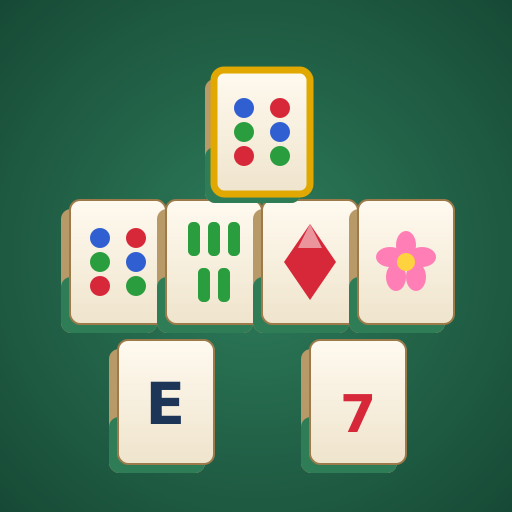
- Three suits, numbered 1 to 9: dots, bamboo and crowns. A tile only matches the same suit and the same number.
- Winds and dragons: four winds and three dragons. Each only matches its exact twin.
- Flowers and seasons: these are special. Any flower matches any other flower, and any season matches any other season, even though the pictures differ.
How many tiles of each kind there are depends on the layout, and it matters more than anything else in this guide:
- On the three smaller layouts (80 or 82 tiles), 31 or 32 kinds appear only twice. Just the dots from 1 to 4 (1 to 5 on Pyramid) appear four times.
- On the big Tower layout (152 tiles), every kind appears four times, and the dots from 1 to 4 appear six times.
The secret: only some tiles can trap you
Here is something most players never notice. Removing tiles can only ever make other tiles freer, never more blocked. So if a kind has exactly two tiles, taking that pair as soon as both are free can never hurt you: those two tiles were always going to be removed together, and taking them early only opens the board.
The danger comes only from kinds with four or more tiles, because then you choose which two go together. Pair the wrong two and the remaining two may end up blocking each other, or blocking another pair that is blocking them. That is the only way a deal here becomes stuck.
We tested this by letting a computer play thousands of deals with completely random (but legal) moves. On Pyramid, Diamond and Twin Peaks it got stuck in only 10 to 18 percent of games, and every one of those came down to the few kinds with four tiles. On Tower, where every kind has four or more tiles, random play got stuck in more than half of all games. That is why Tower feels so much harder, and it tells you exactly where to spend your thinking time.
Strategy for the smaller layouts
- Take two-of-a-kind pairs freely. If you can only see two tiles of a kind, take them when they are free. It is always safe.
- Slow down for the low dots. The dots from 1 to 4 (and the 5 on Pyramid) are the only kinds with four tiles, so they are the only ones that can trap you. Everything else is safe to take on sight.
- With four-tile kinds, prefer the pair that frees the most. If three are free, take the two whose removal frees the most new tiles, and leave the third where it blocks the least.
- If you can, wait until all four are free and take both pairs together. Then the choice can't go wrong.
Strategy for Tower
On Tower every match is a choice, so the general rules matter much more:
- Take tiles from the top of tall stacks first. Each one blocks the tile underneath it, which in turn blocks more. The higher layers should come off early.
- Open the ends of long rows. A long row can only be worked from its two ends, so every end tile you remove makes the next one free.
- Look before you match. Before taking a pair, find the other tiles of that kind. If one of them is buried deep, don't use up the free tiles that could later partner it while easier partners exist.
- Never leave two tiles of a kind where one covers the other. If the last two of a kind are in the same stack, one on top of the other, they can never be matched. Plan your pairs so that this doesn't happen.
The four layouts
- Pyramid (82 tiles, 4 layers): a stepped pyramid. Work from the top down and keep the edges of the wide bottom layer open.
- Diamond (80 tiles, 4 layers): narrow at the top and bottom rows and wide in the middle. The long middle rows are the bottleneck, so open their ends early.
- Twin Peaks (80 tiles, 3 layers): two separate mountains. Work both peaks in parallel, because a kind's partners are often on the other peak.
- Tower (152 tiles, 4 layers): the big one. It takes much longer and punishes buried pairs, so plan ahead and use Undo freely.
Hint, Undo and Shuffle
Undo is free, and it is the best tool you have. If you get stuck, undo a few moves and pick a different pair. Very often one different choice a few moves back opens the whole board.
Hint highlights a free pair but adds ten seconds to your time, so use it when you truly can't see anything.
Shuffle re-deals the tiles that are left onto their current positions, in a way that can still be won. You get three shuffles per game. When there are no matching free pairs left, the game offers a shuffle if one can help. Try Undo first, though: a shuffle changes the whole board, while undo keeps the plan you already had.
Racing the clock
Your best time for each layout is saved in your browser. Speed comes from scanning in a fixed order (top layer first, then the row ends) instead of searching the whole board every time, and from knowing the tile set well enough that matching flowers and seasons stops slowing you down.
Mahjong SolitaireFree to play in your browserPlay