8-Ball Pool Rules and Strategy: Fouls, Ball in Hand and Winning Shots
 8-Ball PoolFree to play in your browserPlay
8-ball is the pool game played in bars and pool halls all over the world, but the rules change from table to table. This guide explains exactly how our 8-Ball Pool plays, which mistakes count as fouls, and the habits that will help you win more racks against the computer or a friend.
The aim of the game
There are fifteen numbered balls. The solids are 1 to 7, the stripes are 9 to 15, and the black 8 ball sits in the middle of the rack. One player owns the solids and the other the stripes. Pot all seven of your balls, then pot the 8 ball, and you win. Pot the 8 ball at any other time and you lose.
The break
- Against the computer, who breaks first is decided at random.
- If any ball goes into a pocket on the break, the breaker shoots again.
- The table stays open after the break, even if balls were potted. Nobody owns solids or stripes yet.
- If the 8 ball drops on the break, it is simply put back on its spot. If the cue ball drops on the same shot, though, the breaker loses.
Hit the break hard and straight into the front ball of the rack. A soft break leaves the balls clustered, which makes the next shots hard for both players.
Choosing your group
While the table is open, you may hit any ball first except the 8. The first ball you pot after the break, without a foul, decides the groups: pot a solid and you are solids for the rest of the game. A good habit is to look at the table before claiming a group. Pick the group with more balls near pockets and fewer balls stuck against cushions or in clusters.
Your turn continues while you pot
You keep shooting as long as you pot one of your own balls without a foul. If you pot only an opponent's ball, or nothing at all, the turn passes. There are no called pockets: a ball of yours that drops by luck still counts.
Every foul, explained
A foul ends your turn and gives your opponent ball in hand: they can place the cue ball anywhere on the table before their next shot. These are the fouls:
- Missing every ball. The cue ball must touch at least one ball.
- Potting the cue ball (a scratch).
- Hitting the wrong ball first. The first ball the cue ball touches must be one of yours. On an open table it can be anything except the 8. Once all your balls are down, it must be the 8.
- No cushion after contact. If nothing is potted, some ball (the cue ball or any other) has to touch a cushion after the first hit. A gentle tap that just nudges a ball is a foul.
How the game is won and lost
- You win by potting the 8 ball, without a foul, after all seven of your balls are down.
- You lose if you pot the 8 ball before your group is cleared.
- You also lose if you pot the 8 ball on the right turn but foul on the same shot, for example by scratching the cue ball into a pocket after it.
Aiming with the guide
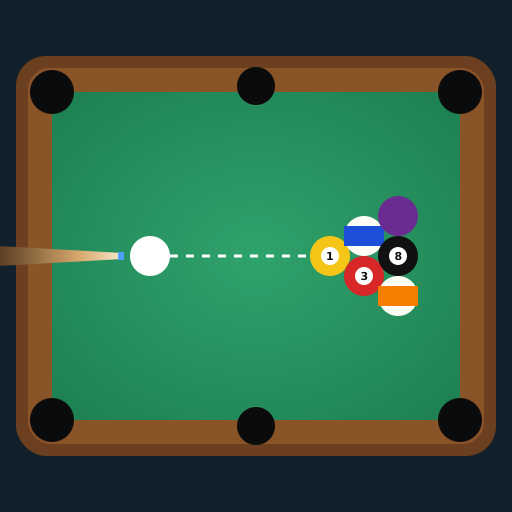
The aiming guide shows a ghost ball where the cue ball will make contact, and a line showing where the object ball will travel. To pot a ball, line up that object-ball line with the middle of a pocket. On a computer you can fine-tune with the arrow keys, and holding Shift makes the adjustment much finer. On a touch screen, drag on the table to aim.
The guide shows the first contact only. Think for yourself about where the cue ball goes after the hit. As a rule of thumb, after a cut shot the cue ball leaves at roughly a right angle to the object ball's path, and after a straight, full hit it keeps rolling forward more slowly.
Power: softer is usually better
Most missed pots in this game are hit too hard. A firm shot makes the ball rattle in the jaws of the pocket, and it sends the cue ball flying around the table so you don't know where it will end up. Use just enough power to reach the pocket. Your next shot depends on where the cue ball stops, and a slow cue ball is a predictable one.
Strategy tips
- Clear the trouble balls early. If one of your balls is stuck against a cushion or in a cluster, deal with it while you still have other balls to fall back on.
- Leave the 8 ball alone. Don't knock it toward the middle of the table or near the opponent's balls. You will need a clear shot at it at the end.
- Play safe when there is no good pot. Hit one of your balls softly so that it reaches a cushion, and leave the cue ball where your opponent has nothing easy. That is a legal shot and gives nothing away.
- Use ball in hand wisely. When your opponent fouls, don't place the cue ball for the easiest pot only. Place it where the pot also leaves you a good angle on the next ball.
- Protect your lead. When you have only one or two balls left and your opponent has many, they will often play safe. Make sure you always have a legal ball to hit first, so you never give away ball in hand.
Playing the computer
The computer opponent comes in three skill levels. On Easy it often misjudges its aim, which makes it a good way to learn the rules. On Medium it pots most straightforward shots. On Hard it rarely misses an open shot and takes full advantage of ball in hand, so your safety play and cue ball control matter. You can also play a two-player game on one device and pass it back and forth.
8-Ball PoolFree to play in your browserPlay